
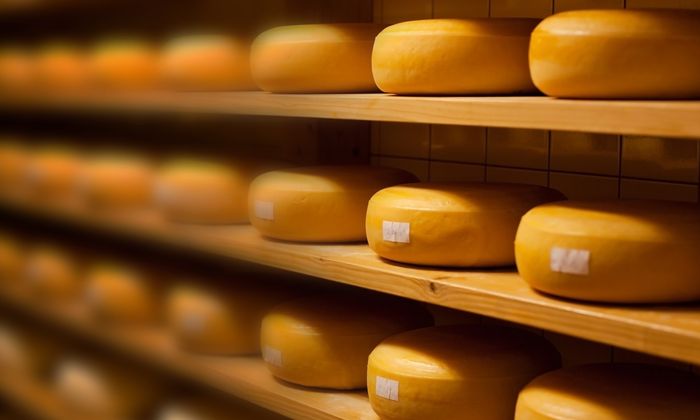
Cheese storage with cheese wheels on wooden shelves for maturing cheese

Cheese ripening and what it's all about.

From A for "affineur" to Z for "ingredients" - here you can find out the most important facts about maturing cheese.

From the original cheese to a variety of cheeses

The main ingredient, milk, and usually only a few other ingredients are used to make cheese. Acidification or the addition of rennet creates a thick mass. Cream cheese, whey cheese and pasta filata cheese such as mozzarella or protinella can be produced directly. Other types require more patience - they need to mature. During the days, weeks or months of ripening, the individual flavour and aroma of the respective cheese specialties develop in addition to their characteristic appearance. Intense flavours are developed through the release of free fatty acids. This explains, among other things, the fact that cheese specialties that are rich in fat are usually the most aromatic. Amino acids and peptides, which are formed as a degradation product of the protein, also make a significant contribution to flavour development.

Hourglass on floorboards to indicate the correct maturing time

Fact 1: Every cheese speciality needs time to mature.

Maturing is one of the most important parts of the cheese-making process and is an integral part of the world of cheese. Every cheese speciality, regardless of whether it is a soft cheese or a hard cheese, needs to mature. Maturing is one of the golden rules of cheese production. But where there are rules, there are of course exceptions. Cream cheese is the only cheese speciality that finds its way onto the cheese counter without maturing for days, weeks or even months. Our mozzarella from GOLDSTEIG also has to mature, but it only needs a very short maturing time of 1 - 3 days.

Piece of Emmental cheese from GOLDSTEIG and thermometer to maintain the right temperature with radishes

Fact 2: The right temperature makes all the difference.

From a biochemical point of view, ripening is influenced by the so-called cheese cultures and coagulation enzymes. Whether a ripening process is crowned with success also depends in some cases on the ripening climate and the temperature in the ripening rooms. Each type of cheese has its own ideal temperature. The ideal ripening period is the key to a successful ripening process. This is also one reason why Emmental has its unique mild and nutty flavour.

Cheese wheels on grids are stored for maturing

Fact 3: Maturation through correct storage.

With the exception of fresh cheese, whey cheese and pasta filata cheese, cheese should be matured for days, weeks and even months, depending on the variety. Maturing can take place in special rooms, for example, in which both humidity and temperature can be kept constant or regulated. The typical holes in the cheese (e.g. in our GOLDSTEIG Emmental) also occur during this ripening process due to the development of gas, for which microorganisms are responsible. In general, the biochemical reactions during the ripening period are extremely complex and vary depending on the variety. The appearance, consistency, flavour and aroma are essentially determined and developed by the changes in protein and fat.

Master of cheese maturing the GOLDSTEIG master cheesemaker with knife and Emmental cheese in hand during production

The masters of cheese ripening.

The craft of maturing and refining cheese requires a great deal of knowledge and experience. Affineurs are cheese masters or cheese refiners. Affineurs have in-depth and comprehensive knowledge. The craft of the affineur could be seen as a craft in its own right. Each of them has their own style and turns each individual wheel of cheese into a personal work of art. Affineurs usually work in cheese cellars and look after their cheeses there. The designation "Maître fromager affineur" is not an official title, but it is the highest title for a cheesemaker. There are only a few hundred people in the world who can boast the title "Maître fromager affineur".