GOLDSTEIG Emmentaler Products

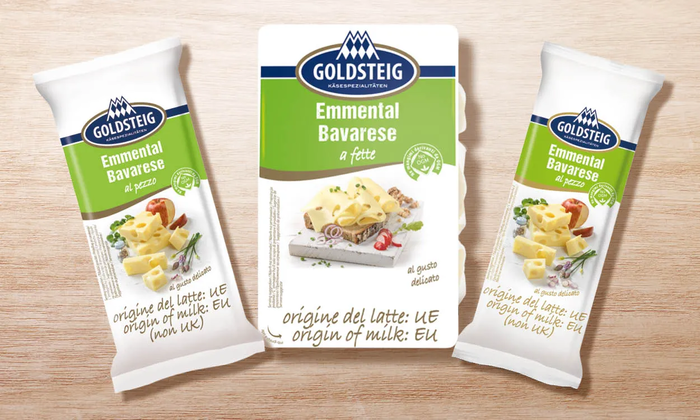
Emmental specialities

GOLDSTEIG Emmental hard cheese is very popular with cheese lovers due to its mild and nutty flavour and is the perfect cheese specialties for a delicious cheese sandwich or a hearty snack. A versatile cheese speciality!

Emmental cheese pieces,
250g and 400g

The piece is perfect for a savoury snack and can also be used in a variety of ways in the hot kitchen. With its nutty, subtle flavour and characteristic holes, it is the favourite of the cheese world.

Emmental cheese slices, 150g

The nutty, fine slices combine the typical flavour with practical handling and are therefore ideal for a hearty snack, delicious sandwiches or for gratinating a main course.

Woman stands in the kitchen wearing an apron and is lifting the lid of the pan. You can see sliced tomatoes lying on the worktop.

GOLDSTEIG recommends!

Surprise friends and family with these smart Emmental recipes, compiled exclusively for you. You can find even more delicious recipes here:

Recipe overview

Emmental recipe Classic cheeseburger with Emmental cheese from GOLDSTEIG, minced meat, lettuce and tomato on a wooden board

Classic cheeseburger with Emmental

  • Up to 15 min.
  • Normal

To the recipe

Mozzarella Käsefacts präsentiert vom GOLDSTEIG Käsemeister mit einem Stück Emmentaler in der Goldsteig Käserei

Amazing things about Emmental!

Presented by our GOLDSTEIG master cheesemaker

Would you have guessed it?

How the holes get into the Emmental cheese

How do holes get into the cheese Goldsteige cheese

Most people will be aware that the characteristic holes in certain types of cheese, such as our Emmental from GOLDSTEIG, are by no means made by mice.

The holes are caused by what is known as propionic acid fermentation. The lactic acid bacteria added to the milk during cheese production produce gases, mainly carbon dioxide. As these can no longer escape due to the rind, they leave cavities in the cheese.

The quantity and size of the cavities depends on the number of lactic acid bacteria and the storage temperature during ripening. The more bacteria and the higher the temperature, the more holes there will ultimately be in the cheese.

The maturity test

Why Emmental is naturally lactose-free

GOLDSTEIG cows on a green meadow with forest in the background. Vegetarian and lactose-free labelling

Around 15% of the German-speaking population suffers from lactose intolerance. This is an intolerance to milk and dairy products. The reason for this is the milk sugar contained in milk, also known as "lactose".

However, many cheese specialties from GOLDSTEIG, including Emmental, are naturally lactose-free. The reason for this is the long maturing time of the cheese specialties. During the ripening process, the lactose is broken down to such an extent that the final lactose content is less than 0.1 %.

Cheese lovers who suffer from lactose intolerance can therefore enjoy GOLDSTEIG's cheese specialities with the "naturally lactose-free" label without any problems.

Who invented it?

That's why there's a real name war over "Emmentaler"

Woman with Swiss flag in front of cows on a green meadow

When you think of cheese, the first thing that usually comes to mind is Emmental cheese and Switzerland. With its holes and individual flavour, Emmental is unmistakable and has long been an integral part of the cheese counter.

However, there has been a long-standing dispute over its name. The fact is that the cheese was invented in Emmental at the beginning of the 19th century. However, this type of cheese not only delighted Swiss cheese lovers, but also met with enthusiasm outside the Swiss borders.

Other countries, such as France, Germany and Austria, produced this cheese shortly afterwards and labelled it as such. The Swiss were only able to protect the term "Emmentaler AOP" in 2000. By this time, however, the name had already spread around the world.

Wafer-thin is "in"

That's why the wafer-thin Emmental is so flavourful

A slice of wafer-thin Emmental cheese from GOLDSTEIG held in one hand

Wafer-thin slices of cheese are becoming increasingly popular, especially for cheese sandwiches. Why is that?

Emmental already has a captivating nutty, delicate flavour when sliced. However, when the cheese is cut into wafer-thin slices, it develops its nutty, delicate flavour even better, as it "practically" melts on the tongue.

Incidentally, there is a legend that monks in the Swiss canton of Jura used to secretly cut a very thin slice from a wheel of semi-hard cheese at night in the hope that nobody would notice. The monks had already realised how tasty wafer-thin cheese can be. Well then - bon appétit!

To the product